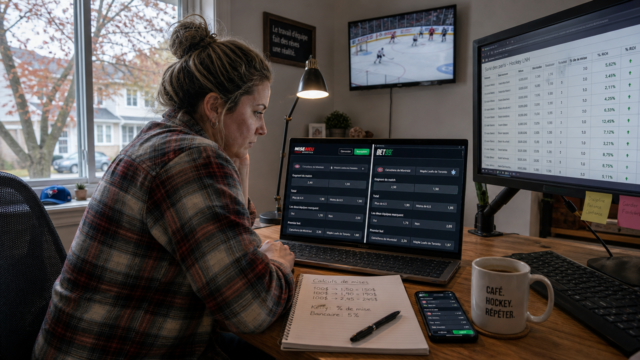

A $300 shift in monthly housing cost changes what a bettor can deposit before any odds or bonuses enter the picture. When the Canada mortgage interest rate rises, sportsbook accounts feel it through smaller reloads, tighter staking, and fewer same-game parlays. When the rate falls, the opposite happens, but only up to the point where rising home prices or stricter lending rules absorb the savings.
The Direct Link Between Mortgage Payments and Betting Deposits
A $500,000 mortgage at 4% over 25 years costs about $2,640 per month. At 5% the payment climbs to roughly $2,925. That one percentage point difference equals $285 a month, or $3,420 a year. For a recreational bettor who deposits $100 to $200 monthly, this swing can cut the sportsbook budget in half without a single losing ticket.
This is why Canada mortgage rate data deserves more attention from online sportsbook players than the latest boosted odds. The central bank was expected to lower rates in 2026, and fixed products offered in Toronto ranged from 4.19% to 4.94% depending on term and lender. As of April 1, 2026, some five-year floating quotes sat between 3.5% and 4%, but global bond market pressure was already pushing rates back up. When lenders reduced discounts on floating products, the gap between fixed and floating narrowed.
Fixed Versus Variable Rate Choice Mirrors Betting Risk Appetite
Fixed rates give payment security. Variable rates depend on the prime rate and offer potential savings with lower prepayment penalties. Over a five-year term the financial difference can be minimal according to Canadian mortgage analysts. The real difference is behavioral.
A bettor who chooses a variable rate because the initial payment is lower is accepting payment uncertainty for short-term cash. That is not different from raising unit size after a few wins. A fixed rate, even at 4.5%, acts like a stop-loss on household cash. You pay more now to know the exact bankroll drain for the next five years.
How Lenders Set the Ceiling on Sportsbook Spending
Lenders size a mortgage using gross debt service and total debt service ratios. The GDS ratio covers mortgage, property tax, heat, and condo fees, typically capped at 32% to 39% depending on the lender. The TDS ratio includes other debts like car loans and credit cards, capped at 40% to 44%. The lower of the two ratios sets the maximum loan. A $450 monthly car payment can reduce mortgage approval by tens of thousands of dollars, forcing a buyer into a higher down payment or a cheaper property. That leftover cash is what funds a sportsbook account.
Minimum down payment rules compound this. Buyers need 5% on the first $500,000, 10% on the next $500,000 up to $1 million, and 20% above $1 million. A $600,000 home requires at least $35,000 down, not $30,000, because the second $100,000 is hit with the higher 10% step. Under 20% down, mortgage insurance adds to the monthly cost. Every dollar locked in a down payment or insurance premium is a dollar not available for entertainment spending.
Credit Strain Changes Betting Behavior
Big banks often reject clients with low credit scores, while mortgage agents can access specialized A-lenders with better terms. This matters for bettors with high credit card utilization. A single maxed-out card raises the TDS ratio and can delay a mortgage approval. The fix is paying down debts before applying, which also drains the cash that might otherwise go to a sportsbook.
Self-employed bettors face a tougher path. Lenders want two years of averaged income from self-employment, not a recent hot streak. A self-employed bettor who relies on variable earnings will likely need a broker and stronger tax filings, not bigger parlays.
Use Mortgage Payment Math to Set Deposit Limits
Every 1 percentage point change in a Canada mortgage rate adds or removes about $57 per month for every $100,000 of mortgage balance on a 25-year amortization. Renewing a $400,000 balance from a 1.8% rate to a 4.5% rate adds roughly $565 monthly. The correct response is not to chase losses with a larger deposit.
Instead, recalculate housing costs after every central-bank announcement or renewal letter. If the payment drops $200, you can safely add $50 to $75 to a sportsbook budget without touching bill money. If it rises $200, cut deposits by at least the same amount for 60 days. The sharpest bettors treat mortgage rate shocks as a forced bankroll reset, not as a reason to borrow from home equity or defer property tax.